Home


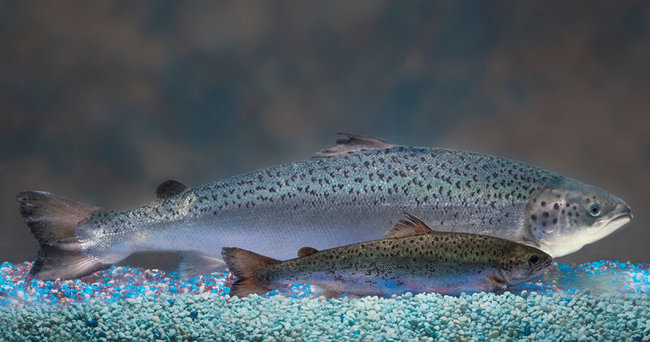
A big fish story in the news just before Christmas featured the enormous salmon pictured above. It's an Atlantic salmon that has been genetically modified to grow twice its normal rate. After a decade of deliberation, the FDA approved this salmon for sale without any restrictions or labeling requirements. When this creature comes to market, the consumer will once again have lost the ability to know exactly what they are buying. If this subject is new to you, check out my post from three years ago. (Link)
There's more. Monday's NYTimes contained a story about two start-up businesses in Anchorage Alaska that are growing hydroponic lettuce for winter consumption. For the first time consumers in a state that imports 90% of its produce can eat lettuce that hasn't frozen en route. One of these small businesses even sells growing units to salad lovers and restaurants. An editorial in the same section of the Times calls for more research to boost our country's stalled agricultural production. It's authors advocate a "green revolution" suggesting projects like eliminating the loss of poultry flocks to avian flu epidemics, treating animals with probiotics rather than antibiotics and developing water-based coatings for lettuce to prevent food poisoning.
The "green revolution" in the 1940's was a benefit to the public and agribusiness. Will a second revolution allow for public oversight? Without full disclosure by farmers, food processors and suppliers, consumers are left to make their food choices without knowing what is actually in the ingredients they purchase.
Author and activist Michael Pollan analysed these issues in the course of writing three books* and came up with a set of what he calls "Food Rules". They have become my mantra. The first one is, "Eat food. Not too much. Mostly plants." "Food" according to Pollan is any fresh ingredient or a manufactured product that contains no more than five ingredients, all of them pronouncable. Everything else in the grocery is a "food product", a creation of the food industry. It's as easy as reading the label on the package.
For a complete list of Pollan's rules, I refer you to his slender book, Food Rules. (there are about fifty of them). Here are some additional practices you may find helpful:
1. Check sell by dates on dairy goods and packaged greens. A useful window is a week to ten days ahead. Use by or best before dates on packaged goods are worth noting but are less important. The manufacturer places them there for quality assurance. It's still safe to eat them past that date. Whether or not they're still as tasty is another question.
2. Avoid fruits and vegetables that are cut up or frozen when fresh whole ones are available. Choosing a different ingredient for a cut-up or damaged one is preferable. I search out firm, heavy for its size, unbruised produce, potatoes without cuts and mushrooms that are unblemished. It takes a little more time, but it's worth it.
3. Ask the butcher for for beef that is grass fed (not finished on grain) and poultry and pork not treated with antibiotics. The freshest fish is wild-caught, not previously frozen and delivered that day. (Farmed salmon is now the norm year-round. Ask about the environmental practices of the farmed operation.) A butcher or fishmonger should be proud to tell you about the quality of their products. If they can't tell you, find a market that will.
To paraphrase the French gastronomer Brillat-Savarin, 'you are what you eat'.
Happy Shopping in the New Year!
* Books by Michael Pollan: The Omnivore's Dilemna, In Defense of Food, An Eater's Manifesto and Cooked, A Natural History of Transformation.

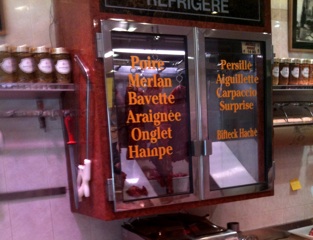
Americans need to pull out a dictionary before ordering steak in France. We discover the French entrecote translates as a rib steak and a faux-filet as a sirloin. Just don’t order it expecting the taste of home. Anthony Bourdain described his first experience with the strong meat flavor and sinewy texture of an onglet (hanger steak) as, “a little scary”. But he was soon hooked.

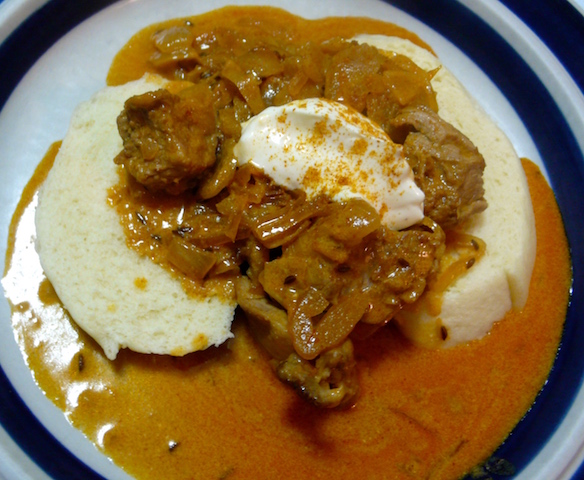
Food is the gift of choice for family members past the age of thirty at our house. A gooey cake and ice cream take a back seat to a meal that celebrates our ethnic heritage. For our son’s recent birthday dinner, I prepared one of his grandfather’s favorite dishes, Székely goulash (gulyás in Hungarian). My father had loved the rich food of his Hungarian childhood, and this devotion continues to nurture the memory of successive generations.
Like my father’s family who had immigrated from Russia in the 19th century, Székely goulash is a recent import from Transylvania. Unlike the traditional gulyás prepared by ‘cowboys’ who herd cattle on Hungary’s southern plains, this modern stew is better suited to a family setting. In place of the original mix of tough cuts of beef, wild onions, caraway and paprika simmered slowly in a cauldron over a fire, Székely goulash is made with pork, garlic, sauerkraut and sour cream.
The attraction of this updated version of goulash is the speed with which it delivers essential flavors of Hungarian cuisine. Onions are softened in a heavy skillet with garlic then pushed to the sides of the pan. Pork tenderloin nuggets are browned in the center then covered with a little flour and lots of sweet Szeged Paprika (sold in a red tin at my local Jewel) and caraway seeds. It takes less than 15 minutes for the lean pork to cook through after a meat stock is added. Stir in sour cream, and Voila! (or whatever they say in Hungarian)
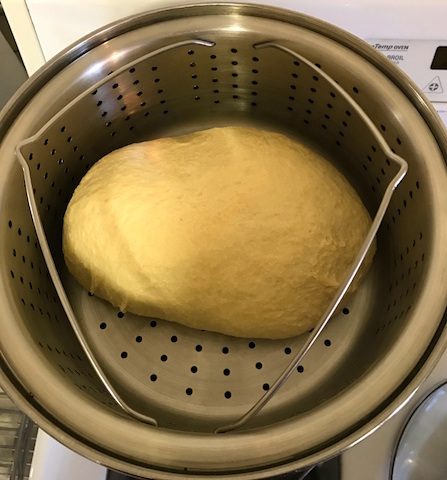
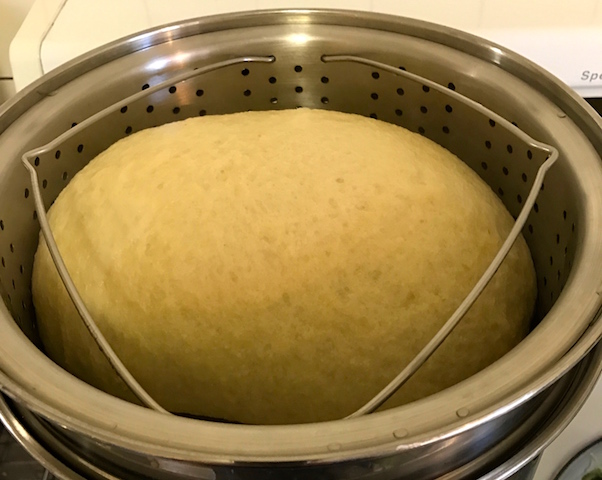
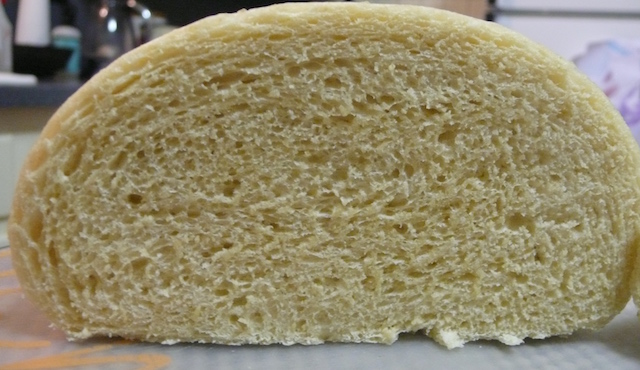
Boiled potatoes or egg noodles are the traditional starches that accompany this stew, but I prefer to serve a slice of steamed yeast dumpling. The dough is easy to assemble and doubles in size in an hour. I nestle the risen dough in the steamer basket of my pasta pot over simmering water and steam it for about 20 minutes. The loaf rises impressively and slices easily fresh out of the pan. The yeast dumpling acts like a bread sponge and soaks up the rich juices of the Székley goulash. Their combined flavors stimulates a wealth of childhood memories of an ephemeral past.

Americans have been influenced by French food and wine since Thomas Jefferson served dinner à la française at Monticello. Today french fries, french onion soup and chocolate mousse can be found on menus in modest cafes as well as gourmet restaurants. The French, in turn, have adopted famous American brands as their own. Bottles of Heinz ketchup, Coca Cola and the tell-tale Starbucks paper cups are highly visible on tables in Paris. On balance, I believe we've gotten the better deal. But occasionally an American food trend that's not promoted by a billion dollar multinational corporation penetrates the food culture of France, and tips the scale in the other direction.
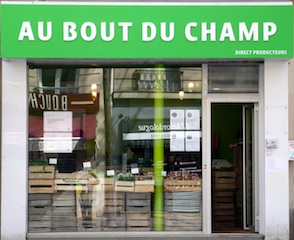
A shining example can be found in a new storefront up the street from our Montmartre apartment. The sign above the door says it all: Au Bout du Champ, literally "at the end of the field". The manager proudly told me the shop was inspired by the American locavore movement that began in California in the 1970's. But that was forty years ago! The incentive to eat locally grown, organic foods that Alice Waters championed at Chez Panisse has long since evolved into networks of farmers' markets and farms that sell shares of their harvest through Community Supported Agriculture (CSA) memberships.
France has been moving in parallel at its own pace. Au Bout du Champ is a member of AMAP whose founder, Robert Vuillon, a farmer in Provence (Toulon) was inspired to sell directly to the public after discovering a farmers' market on a visit to New York City in 2000. Members of AMAP (Agriculture pour la maintien d'une agriculture paysanne) sell their produce directly to the consumer at prices that guarantee them a decent living. Some produce is organic but landowners for whom organic certification is too expensive respect the environment by using as few chemicals as possible.
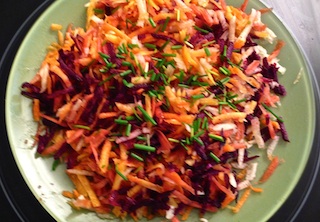
Grated carrots dressed with olive oil, lemon juice, garlic and chives.
What I find interesting about French locavore movement is AMAP's use of the word paysanne (peasant) instead of farmer or artisan. 'Politically correct' America would not choose such a socially-charged word. In medieval Europe, a peasant was an impoverished laborer who worked with his/her hands for a landowner. AMAP's members are asking for the right to make a decent living in a time-honored way. Respect for the 'rights of man' is a sacred concept in France. It's also uncannily reminiscent of the free speech movement in Berkeley in 1960's which preceeded the locavore movement of the 70's.
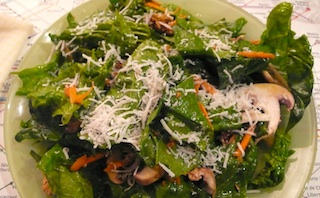
Dressing is walnut oil and walnut vinager
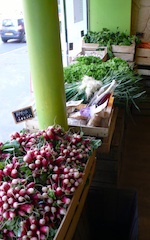
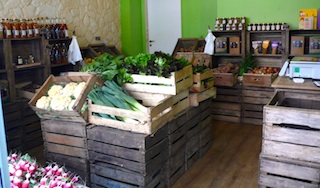
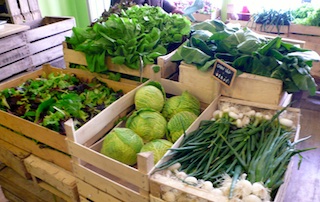
True to its AMAP mandate, Au Bout du Champ is filled with food items grown within 100 km (62 miles) of the storefront. The roughly twelve foot square space is packed with wooden crates of fresh vegetables that were picked that morning. Shelves above the tables hold hand-sorted grains, honey, eggs, fruit juices and homemade fruit preserves.
This far north in France the selection is still dominated by root vegetables: potatoes, leeks, carrots, beets, turnips, Jerusalem artichokes. Spring produce includes radishes, green onions, spinach, lettuce, chard, cabbage and cauliflower. Apples and pears from last year's harvest are the only fruits available this early in the year. Like so much of Montmartre, this shop is totally without pretense There's no way Au Bout Du Champ is going to morph into the next Whole Foods.
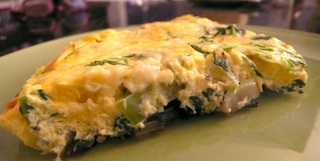
Chard Frittata with spring onions,garlic and vacherin cheese (or cheddar)
Preparing meals with produce from Au Bout Du Champ feels like cooking in the French countryside. Spinach leaves are large, dark and chewy; carrots are firm and sweet; the golden apples have a mild floral aroma of roses. The truth is, most purveyors at the daily street markets and the large groceries chains throughout Paris are supplied by the vast central market at Rungis on the outskirts of town where 'bio' (organic) produce has only a small presence. Au Bout Du Champ is at the forefront of the changing food culture of Paris, and we have only ourselves to thank.