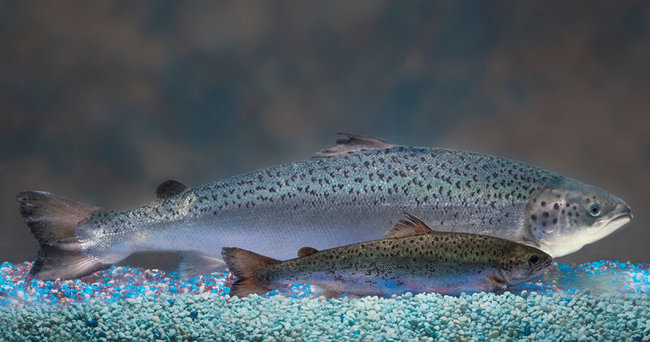
A big fish story in the news just before Christmas featured the enormous salmon pictured above. It's an Atlantic salmon that has been genetically modified to grow twice its normal rate. After a decade of deliberation, the FDA approved this salmon for sale without any restrictions or labeling requirements. When this creature comes to market, the consumer will once again have lost the ability to know exactly what they are buying. If this subject is new to you, check out my post from three years ago. (Link)
There's more. Monday's NYTimes contained a story about two start-up businesses in Anchorage Alaska that are growing hydroponic lettuce for winter consumption. For the first time consumers in a state that imports 90% of its produce can eat lettuce that hasn't frozen en route. One of these small businesses even sells growing units to salad lovers and restaurants. An editorial in the same section of the Times calls for more research to boost our country's stalled agricultural production. It's authors advocate a "green revolution" suggesting projects like eliminating the loss of poultry flocks to avian flu epidemics, treating animals with probiotics rather than antibiotics and developing water-based coatings for lettuce to prevent food poisoning.
The "green revolution" in the 1940's was a benefit to the public and agribusiness. Will a second revolution allow for public oversight? Without full disclosure by farmers, food processors and suppliers, consumers are left to make their food choices without knowing what is actually in the ingredients they purchase.
Author and activist Michael Pollan analysed these issues in the course of writing three books* and came up with a set of what he calls "Food Rules". They have become my mantra. The first one is, "Eat food. Not too much. Mostly plants." "Food" according to Pollan is any fresh ingredient or a manufactured product that contains no more than five ingredients, all of them pronouncable. Everything else in the grocery is a "food product", a creation of the food industry. It's as easy as reading the label on the package.
For a complete list of Pollan's rules, I refer you to his slender book, Food Rules. (there are about fifty of them). Here are some additional practices you may find helpful:
1. Check sell by dates on dairy goods and packaged greens. A useful window is a week to ten days ahead. Use by or best before dates on packaged goods are worth noting but are less important. The manufacturer places them there for quality assurance. It's still safe to eat them past that date. Whether or not they're still as tasty is another question.
2. Avoid fruits and vegetables that are cut up or frozen when fresh whole ones are available. Choosing a different ingredient for a cut-up or damaged one is preferable. I search out firm, heavy for its size, unbruised produce, potatoes without cuts and mushrooms that are unblemished. It takes a little more time, but it's worth it.
3. Ask the butcher for for beef that is grass fed (not finished on grain) and poultry and pork not treated with antibiotics. The freshest fish is wild-caught, not previously frozen and delivered that day. (Farmed salmon is now the norm year-round. Ask about the environmental practices of the farmed operation.) A butcher or fishmonger should be proud to tell you about the quality of their products. If they can't tell you, find a market that will.
To paraphrase the French gastronomer Brillat-Savarin, 'you are what you eat'.
Happy Shopping in the New Year!
* Books by Michael Pollan: The Omnivore's Dilemna, In Defense of Food, An Eater's Manifesto and Cooked, A Natural History of Transformation.
