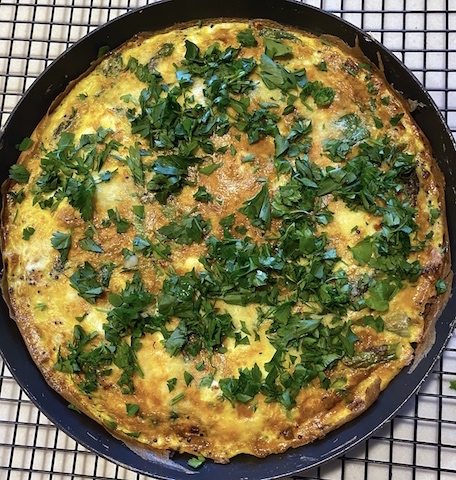
STAY-AT-HOME QUINOA AND ASPARAGUS FRITTATA


The national mood shifted over the weekend as swiftly as a weather front from gloom in lockdown to hope of a gradual return to public life.  A nagging question remains: will wearing a mask and observing social distancing be enough protection from a potent virus?  With facts changing every day in the news, my response is to become more proactive in the kitchen.

In short, my comfort zone now includes nutrient-rich foods.  Michael Pollan is my coach, and I faithfully follow his basic rule to eat fresh food, not too much and mostly plants.  When tempted to stray, the immortal words of French food philosopher, Brillat-Savarin, ‘you are what you eat’, remind me that a strong immune system is my first line of defense against the enemy.

Brillat-Savarin’s late 19th century diet appears rarefied by today’s standards. but it was remarkably disciplined.  He ate few carbs, avoided sugar and advocated for vegetables and fruits. His idea of an omelet filling is a combination of carp roe and fresh tuna. He would have been amazed to see me replace rich seafood with quinoa seeds in the frittata I prepared last weekend. 

Quinoa is one of today’s ‘superfoods’, a marketing term that is synonymous with nutritional density.  Quinoa has the distinction of containing all nine amino acids that make up the essential building blocks of protein as well as high levels of iron, potassium and fiber.  This tiny seed has sustained indigenous people living along the spine of the Andes in Bolivia, Peru and Chile for 7,000 years.  Spanish invaders replaced quinoa with rice and wheat crops in the 16th century.  It was rediscovered in the middle of the last century and its cultivation has since spread around the world.

Be sure to rinse off quinoa seeds before cooking to remove a natural, bitter coating designed to discourage bugs and birds in the wild.  Quinoa cooks in 15 minutes in twice its volume of water doubling in volume as it cooks.  Seeds are available in a variety of colors, from white to red, yellow and black.  The seeds crack during cooking to produce a small curled white tail.  They pop in the mouth when you bite down releasing a satisfying earthy aroma. 
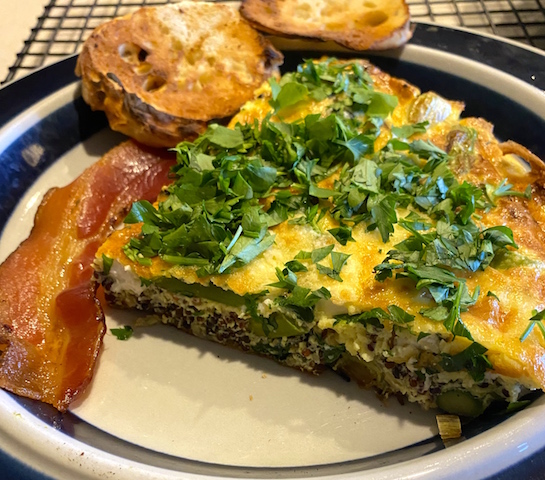
 

QUINOA AND ASPARAGUS FRITTATA

Ingredients for 4 servings:

1/2 cup red quinoa

8 large eggs

1/2 teaspoon salt

1/2 cup feta cheese, cut into small cubes

1 tablespoon whole grain mustard

2 tablespoons olive oil

1 small red onion, peeled and diced 

1 leek, white portion, thinly sliced

1 clove garlic, minced

10 asparagus stalks, trimmed and cut into 2" lengths

1/4 cup water

1 cup baby spinach leaves, tightly packed

1/4 cup grated romano cheese

1/4 cup Italian parsley leaves, chopped 

Rinse the quinoa under cold running water.  Simmer it in 1 cup water until it is tender, about 15 minutes.  Drain any remaining water, and reserve. Beat the eggs with the salt and allow to stand for 15 minutes.  Mix in the feta cheese pieces and mustard.  Reserve.

Select an ovenproof, non-stick skillet to heat the olive oil in and soften the onion and leek pieces over medium low heat.  Stir in the garlic and cook an additional minute. Add the asparagus pieces, the water, cover the pan and cook for 5 minutes.  Uncover and sprinkle the spinach over the surface.  Cook until it has wilted and any remaining water in the skillet has evaporated.  Stir the quinoa into the egg mixture and pour it over the leek and asparagus mixture.  Shake the pan to help distribute the eggs evenly.  Cook for 2 -3 minutes, run a spatula around the edge of the skillet to release the  edges.  When the bottom of the omelet is browned, sprinkle on the grated cheese and place the skillet in the oven 4" below the broiler.  Remove when the surface is set and lightly browned.  Scatter on the parsley and serve immediately.


STAY-AT-HOME SOUFFLE PANCAKES


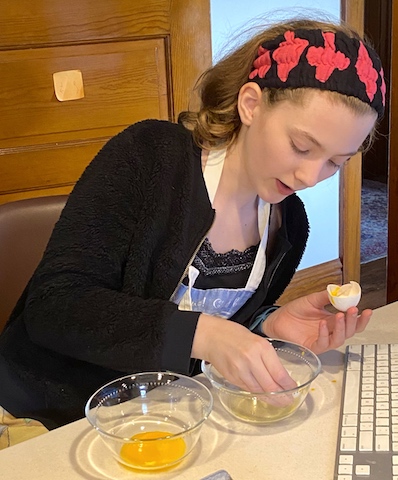
Once I decided to  teach cooking classes online from my home kitchen, my daughter began sending suggestions in the form of posts from her favorite social media sites.  What does recipe-sharing currently look like online?   The first one that arrived was a one minute TikTok video of Maddy (no relation), a young Asian girl with a soft voice and pink hair, preparing Souffle Pancakes.  As unlikely as it might seem, this one minute video turned out to be a teachable moment. 

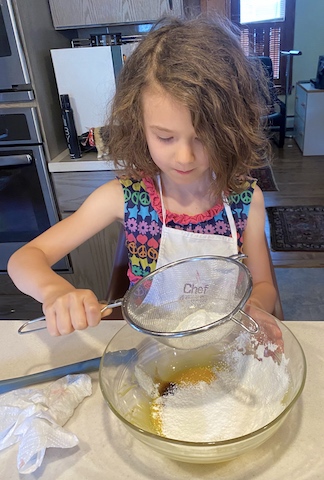
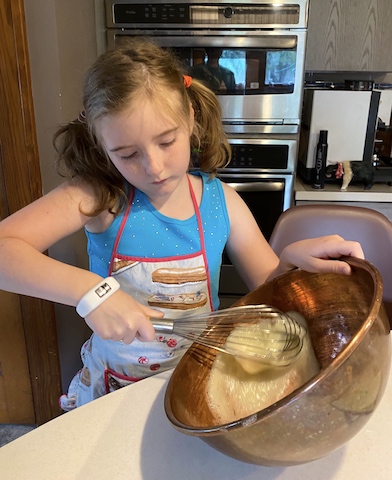
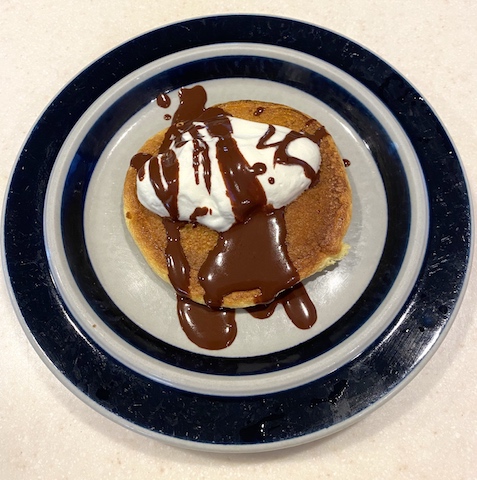
No, I am not gearing up to teach a recipe in one minute.  Ditto for dying my hair a color not found in nature.  On the other hand, the subject itself was too intriguing to just discard.  After the many viewings required to write down the ingredients and visualize the recipe, I called in my granddaughters to help me give it a test drive. Puffy pancakes with whipped cream and chocolate sauce are irresistable to kids of all ages, and Maddy’s concise editing made the process look easy.  We also had all the ingredients she mentioned already on hand: 2 eggs, 2 tablespoons milk, 2 tablespoons flour, 2 teaspoons baking powder and a few drops of vanilla extract.
 
I knew we were in trouble as soon as we sifted the dry ingredients into the egg yolks and milk.  Our mixture became dry and cracked when we stirred it.  Maddy’s version was thick but smooth and moist.  The addition of two additional tablespoons of milk solved the problem.
                   
.        
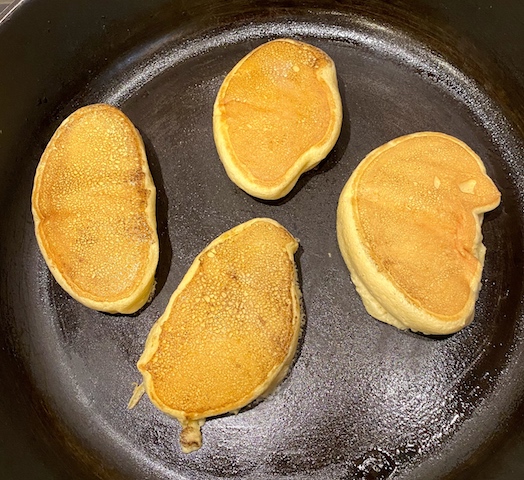
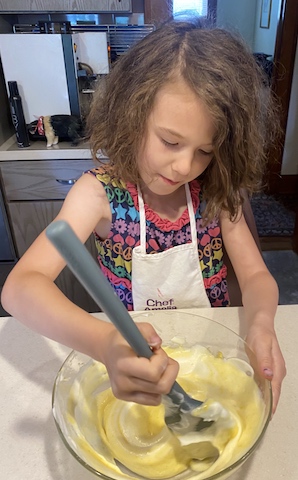
                First batch of pancakes in the pan.          Celeste folds in the egg whites       The finished product!!!
We beat the egg whites as directed, but they didn't look as firm as Maddy’s.  Wait, we added sugar!  She hadn’t mentioned sugar among the ingredients.  We quickly beat two tablespoons into the whites for another quick save. The final step of folding the whites into the yolk mixture went off without a hitch. 
The disks of fluffy batter baked in six minutes as promised.  The girls were pleased with their success and the pancakes quickly evaporated from their plates.  My takeaway was a renewed appreciation for the role of visual memory when following recipe directions.  I plan to record my Zoom classes and make a copy available to everone who attends.
SOUFFLE PANCAKES
Ingredients for 2 servings:
2 large eggs at room temperature, separated
3 tablespoons milk
1/4 teaspoon vanilla extract
2 tablespoons unbleached flour
2 teaspoons baking powder
2 tablespoon granulated sugar
Stir together the yolks, milk and vanilla extract in a mixing bowl.  Sift on the flour and baking powder.
Beat the egg whites to firm peaks adding the sugar slowly as the whites rise.  Gently fold the whites into the egg and flour mixture.
Oil and heat a large skillet on a cooktop.  Carefully spoon out 4 pancakes onto the pan.  Dot 1/2 teaspoon water in two or three places around the outside of the pan.  Cover and cook the pancakes for 6 minutes, carefully turning them after 3 minutes.
Serve immediately with whipped cream and chocolate sauce.
 

STAY-AT-HOME STRAWBERRY RHUBARB GALETTE

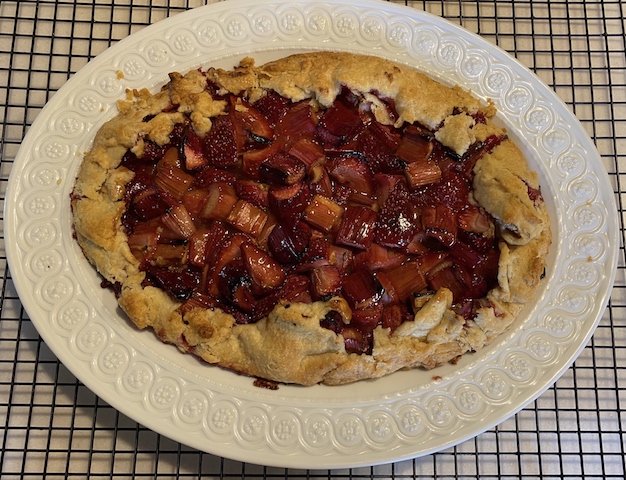
French pastry is as easy as apple pie. In fact, the French version of American pie is easier and tastier than the original. It is easier because there’s only one pastry layer and no constricting pie pan. Tastier because French pie pastry is made with butter rather than shortening. This French take on an American classic, called a galette, provides a delicious way to showcase your favorite summer fruits.

The term galette is a good example of the many references a French word can possess (much to the frustration of language students). The unappetizing dictionary definition for it is: a flat, round cake. In real life, a galette can be anything from a Breton buckwheat crepe to a yeast-risen Mardi Gras King cake. To ask the meaning of a food word in French is like asking an Eskimo to define snow.

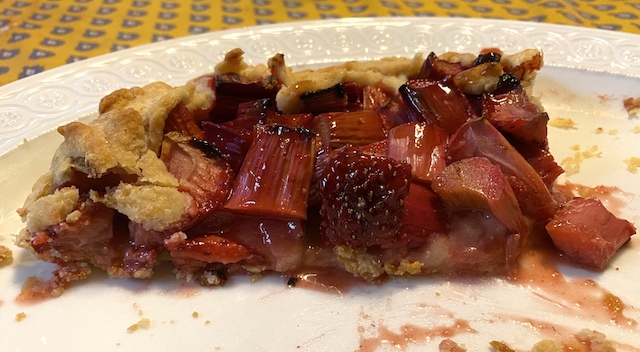
The galette has found its way onto menus in the past two decades with the rise of casual dining. Its rustic, you might say, slightly unkempt look is part of its appeal. If some juices are seeping out and the crust is uneven, so much the better.

The recipe below comes from Jacques Pepin Celebrates (2001). Jacques Pepin has lived in the States for sixty years, first as a super-star French chef, then as an exacting teacher to home cooks. I admire the ways in which, over the years, he has adapted his formidable technique to the modern American taste for simplicity.

One note of caution when you make this galette: The all-butter crust will soften rapidly even in an air-conditioned kitchen. Work quickly, and place the filled galette in the freezer for 10 minutes before baking to insure that the pastry rim stays folded in place. For easier handling, use the crust ingredients for the Turkey Pot Pie in which some of the butter is replaced by shortening. Either crust will complement the fruit filling beautifully.   

 STRAWBERRY RHUBARB GALETTE

Ingredients for 8 servings
Pâte Brisée Dough:

1 1/2 cups unbleached flour

1/4 teaspoon sea salt

6 ounces (1 1/2 sticks) cold, unsalted butter, cut into 1/2" pieces

1/3 cup ice cold water

Filling:

1 pound rhubarb, rinsed, ends trimmed, cut into 1 inch pieces

1 pound strawberries, rinsed, hulled and halved

1/3 cup sugar

Bottom layer:

3 tablespoons flour

3 tablespoons ground almonds or almond flour

1/4 cup sugar

Glaze: 3/4 cup seedless raspberry jam or red currant jam, melted

Dough: Pulse the flour salt and butter pieces in with work bowl of a food processor for 5 seconds or work by hand with a pastry blender until the butter is coated with flour and the consistency of coarse sand. Add 3 tablespoons of the water and process another 5 seconds until the dough is just coming together and pieces of butter are still visible. Do the same if working by hand. Add more water by the tablespoon until the begins to form. Remove the dough from the bowl,  Quickly flatten the dough, dust with flour on both sides and roll it out between layers of parchment to a 8" x12" rectangle.  Refrigerate the dough for 20 minutes while preparing the filling. 

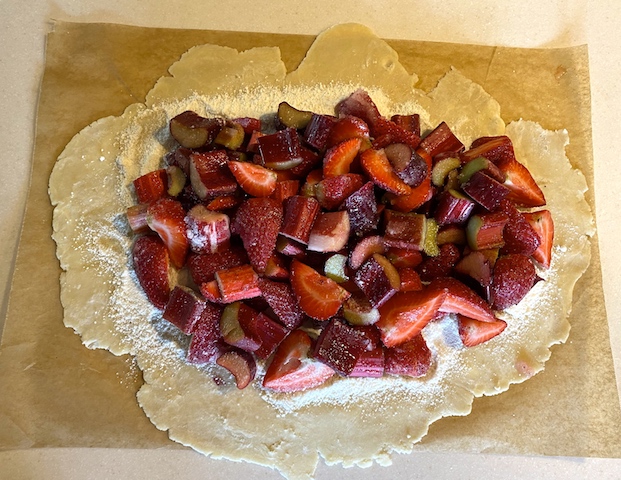
Filling and Baking: Preheat the oven to 400 degrees.  Assemble the dry ingredients.  Toss the strawberry and rhubarb pieces with 1/3 cup sugar in a mixing bowl.  Remove the dough from the refrigerator.  Roll it out into an oval 16" long, 14" wide and 1/8" thick.  Spread the dry mix over the rolled dough to within 2" of the edge. Pile the strawberry rhubarb mixture on top. Draw up the sides of the dough around the fruit pieces holding them in place until they soften enough to form a crust.  Slide the galette onto a bake sheet and place in the freezer for 10 minutes.  Bake for 45 minutes to 1 hour, until the crust browns. Loosen the galette on the bake sheet if juices have escaped during baking so it won't stick when cooled. 

Spread on the glaze over the galette while it is still warm. Serve at room temperature with whipped cream if desired.


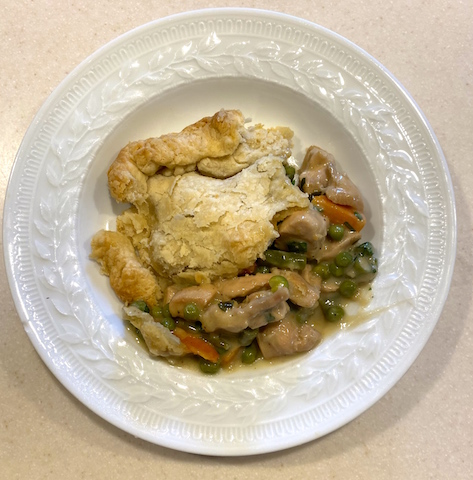
STAY-AT-HOME TURKEY POT PIE

This weekend, Americans will fire up their grills to celebrate the beginning of a summer living in the shadow of a pandemic.  What’s wrong with this picture?  After almost three months of faithfully washing our hands, wearing masks in public and social distancing, we will face the one season that encourages us to ignore all these habits. 

In summer we enjoy gathering outdoors for picnics at parks and beaches.  We are more likely to eat food with our hands that others have touched, often from a communal platter.  Our 'new normal' will fluctuate, as the progress of an invisible enemy is recalculated from one day to the next.  When conditions get this stressful, I retreat from warm weather fare to the warmth of old-fashioned comfort foods like turkey pot pie.

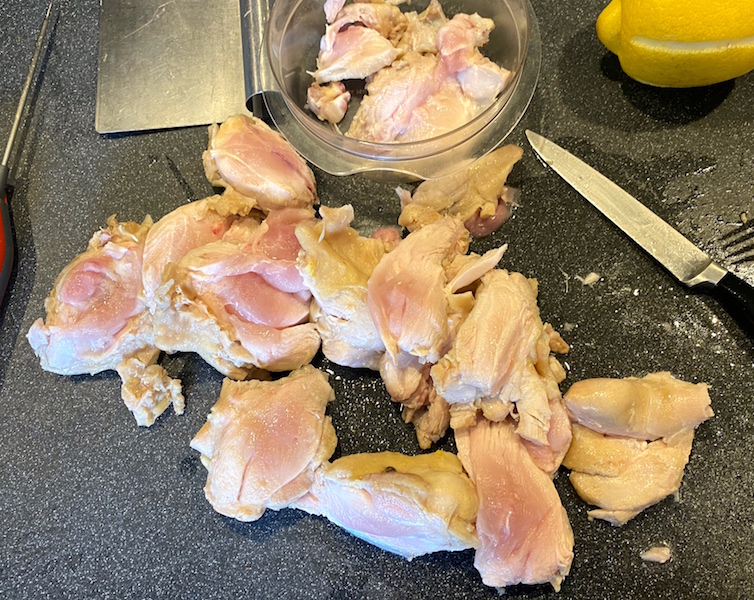
 Blanched, deboned and skinned turkey wingettes

There is something inherently satisfying about a one pot meal with its wholesome, concentrated flavors of meat and vegetables.  A pastry lid of contrasting texture and richness turns this combination of everyday ingredients into a feast.  To this classic recipe I offer a few tips to speed of its preparation without sacrificing quality.

The ingredient that guarantees quality is a good, honest broth.  My go-to vegetable stock takes one and one-half hours to prepare, most of the time unattended.  Blog reader and longtime student Judith Campbell wrote to me of her success making chicken stock overnight in an slow cooker from the carcass of a roast chicken and the usual vegetables.  I was ready to purchase one, had I  the space on my counter for it.

Turkey thighs, drumsticks or wingettes (the meaty upper portion) will work in this recipe.  These dark meat pieces are flavorful  but tough.  My timesaving method involves a quick blanching of whole pieces, then boning, removing the skin and cutting the meat into bite size pieces across the grain.  A short period of continued cooking with the vegetables tenderizes the meat more quickly than a long braise of whole pieces.

To make the pastry more user-friendly, I replace some of the butter with shortening which is solid at room temperature thus easier to roll out.  If you use butter exclusively, chill the dough longer after forming it and before baking.  Another shortcut is the substitution of a cornstarch thickener for the classic French sauce veloute made with butter and flour. roux


TURKEY POT PIE 

Ingredients for 8 servings:

Stock:

4 - 5 cups vegetable stock  or chicken stock

4 pounds turkey thighs, wingettes or drumsticks

Vegetables:

1 cup frozen white pearl onions

1 cup frozen petite peas

1 cup green beans, cut in 1" pieces

1 cup carrots, peeled and cut into 1/2" slices

1/4 cup fresh herbs, minced (flat leaf parsley, chives, tarragon)

Sauce:

1/2 cup whipping cream 

2 tablespoons cornstarch, dissolved in 2 tablespoons water

kosher salt and pepper to taste

Tabasco, to taste 

Pastry Crust:

1 – 2/3 cup unbleached flour

1/2 teaspoon sea salt

8 tablespoons cold, unsalted butter

4 tablespoons shortening

3-4 tablespoons iced water

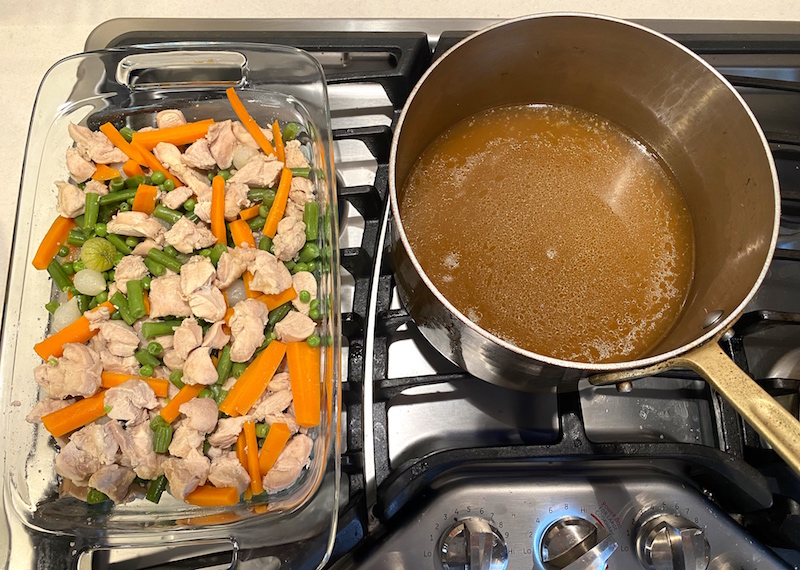
Turkey/Vegetables/Veloute:  Prepare a vegetable or chicken stock.  Rinse the turkey pieces and place them in a large saucepan.  Cover the meat with stock, adding water if needed to cover the pieces.  Bring to a simmer and cook for 15 minutes.  Meat will be firm but not fully cooked.  Remove the turkey pieces and, when cool enough to handle, remove the bones and skin.  Return the bones to the stock and continue simmering.  Cut the meat across the grain into 1/2" bitesize pieces.  Remove the bones, return the meat pieces to the stock and simmer another 10 minutes.  Add the vegetables to the stock and simmer another 10 minutes.  Strain the stock from the vegetables.  Reduce the stock to 2 cups.  Add the cream and reduce again to 2 cups.  Stir 1/2 cup of the sauce into a slurry of cornstarch and water.  Pour this back into the pot, stir as the sauce thickens and cook for 2 minutes, stirring continuously.  Season to taste with salt, pepper and Tabasco.  Fold this sauce and fresh herbs into the meat and vegetables and distribute in a heavy 2 quart casserole.

Pastry: Mix the flour and salt in the work bowl of a food processor, electric mixer or mixing bowl.  Add the butter cut into ½” pieces and blend to the texture of coarse sand.  Work in the shortening the same way.  Add 3 tablespoons iced water in rapid succession with the machine running or all at once if by hand.  If a dough does not form easily, add an additional tablespoon of water.  Place dough on a floured sheet of wax paper.  Sprinkle dough with flour, and lay on another sheet of paper.  Carefully press the dough into a disk or rectangle about the size of your casserole.  Cover the dough and refrigerate for 30 minutes.

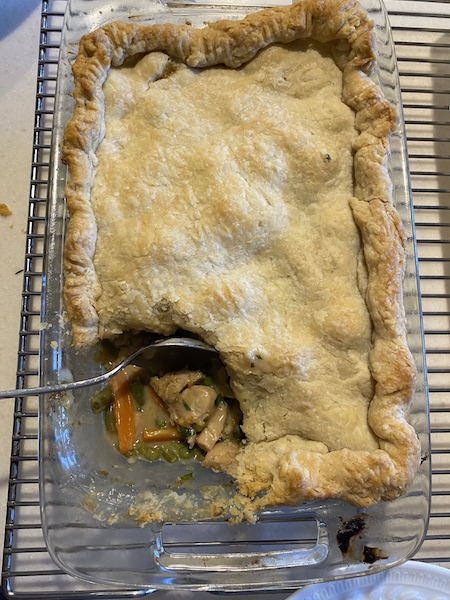
Assembly and Baking:  Center the oven rack and preheat the oven to 400 degrees.    Finish rolling the dough so that it is 1" larger than the opening of the casserole on all sides.  Lift off the wax paper, and turn the dough over on the pie filling.  Remove remaining sheet of paper and crimp the dough around the edges of the pan.  Bake for 45 minutes or until the pie is golden and bubbly.