SUMMER IN A JAR


jamtoast

There are certain flavors that arouse to my foraging instincts.  Among them is the taste of freshly made black raspberry jam and warm biscuits on summer mornings.  This year, perfect wild berries magically appeared at the local farmers’ market before I could get out my bug repellant.   I was both delighted and saddened.   Now I wouldn't have  to gather them myself.  That’s good news.

Summer in a Jar

Jam2

SUMMER IN A SANDWICH

pan bagna1

There’s one sandwich that seems to have everything going for it: crusty bread layered with chunks of tuna, sliced hard-boiled egg, garden tomatoes, olives and crunchy raw vegetables.  Is it just a sandwich or is it salad?  Both, actually.  Pan bagna, is a Niçoise salad enshrined in a sandwich.  It’s the perfect centerpiece for a casual picnic or  terrace dining on a hot summer evening with a glass of rosé.

PanBagna2

Pan bagna is Provençal French for moistened bread, not soaked, just softened as in bread salad.   It’s essential to select a flat crusty loaf with a coarse texture that will soak up juices.   Italian ciabatta bread is perfect.  

PanBagna3


Anyone who loves working with Provençal ingredients will enjoy constructing a pan bagna.  Work begins at least one-and-a-half hours before serving.  The bread is halved along its length and the interior is removed to make room for the filling.  The surface of the bread is rubbed with a halved clove of garlic followed by the cut surface of a halved tomato.  The exposed bread halves are then lightly seasoned with olive oil and red wine vinegar.

The filling consists of successive layers of white albacore tuna, sliced tomatoes, hard boiled eggs and anchovies.  At this point, the sandwich looks full, but there’s more!  This filling is covered with a tossed salad of romaine and basil, Niçoise olives, celery, scallions and yellow bell pepper.  On other occasions I’ve substituted thinly sliced zucchini, fennel or radishes. It depends on how much crunch you want.

PanBagna4

After mounding the salad over the filling, the hollowed-out lid of the ciabatta bread is put in place.  The loaf then needs to sit an hour before serving so the juices from the filling can continue to penetrate.  First wrap it tightly in plastic, then weight it evenly and hold it at room temperature for an hour or longer.  Enjoy!

PanBagna5


One pan bagna will serve eight persons.  It's worth making a whole loaf even if you're only two or four.  Pan bagna tastes delicious served cool from the refrigerator the next day.

Here is the link to the recipe:  http://www.chezm.com/welcome-to-recipes/59-uncategorized/807-sandwich-nicoise-salad
TAKEAWAYS FROM SOUTHWEST FRANCE


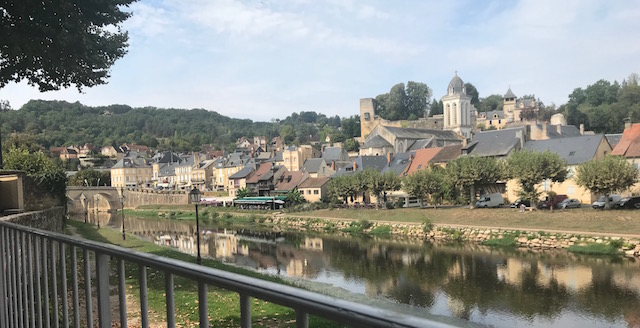
The Vezere River from Site de la Madeleine

Visitors to the serene valley of the Vezere River in southwest France come prepared to discover exciting links to human prehistory A single road along the river connects carefully preserved sites where homo sapiens found shelter and food some 20,000 years ago.  At Site de la Madeleine (no relation, the name refers to time period) I could envision standing guard on a ledge above the river scanning for boats from shelters upstream. On a tour through the newest cave replica of Lascaux, we all gazed with childlike wonder at herds of enormous animals painted on the walls of its narrow passageways.
Replica of cave paintings at Lascaux IV
Our English guide at the Museum of Prehistory in nearby Les Eyzies-la-Tayac showed us examples of early man's technical prowess as hunter and artist. Museum displays of recovered objects are interspersed with dioramas and videos that demonstrate how skillfully early man made weapons and turned softer pieces of animal hide and shells into elaborate headdresses. (A beautiful example is in the collection of Chicago's Field Museum.)  
This phantom world of distant past evaporated as we drove through in the rolling Dordogne countryside.  Gaggles of ducks and geese have replaced the thundering herds of bison and antelope.  Confit of duck and foie gras appear on every menu.  Prehistoric residents would be amazed to see the handsome chateaux and fortified villages built along the Vezere since the 12th century century as global warming after the ice age allowed plants and woodlands to flourish.
                        
View of the town of Montignac on the Vezere River and Confit de Canard
Our quest for an Saturday market was easily filled in nearby Sarlat-le-Caneda, a town first settled in Gallo-Roman times.  The town center swells in the morning with tourists and locals eager for locally grown foods and regional specialties. At stop for coffee in Place de la Liberte, the heart of the market, allowed us to time travel again as we watched shoppers and vendors play out their time-honored roles against the backdrop of the 12th century Cathedral of Saint Sacerdos. That evening in Montignac, we dined on market ‘finds’ in potluck fashion: cheeses from Rocamadour and the Auvergne; bread baked in a wood-fired oven; thinly sliced smoked duck breast; fresh walnut cake and an assortment of locally-grown strawberries.  All of it washed down with local wine from Cahors.
A trip to southwest France would be incomplete without a visit to the winemaking area of Bordeaux.  The most surprising takeaway for me, having let almost two decades elapse since my last visit, was the dramatic change in winemaking practices underway.  Bordeaux wines are traditionally made predominantly with cabernet sauvignon grapes that are structured to mature over a period of 10 to 20 years.  We learned as we toured properties in Saint Emilion that 85% of the wine purchased today is drunk within 48 hours.  This news whetted my appetite (sorry) to learn more about 21st century winemaking in Bordeaux on future visits.
Bar in a Bordeaux Bistro on a Saturday evening
Our group of travelers spent the final afternoon in Bordeaux's 'golden triangle' of luxury shops for gifts to take home. Another takeaway was the new energy I sensed in this ancient port city.  Bordeaux now has an extensive tram system that accelerates travel through the city center, out into the surrounding winegrowing areas and along the wharf whose once abandoned warehouses are now filled with small shops and dining spots.  An ambitious wine museum, Cite du Vin, opened in 2016 and across the street a barn-like food mall called Les Halles de Bacalan awaits anyone interested in casual dining elbow-to-elbow with les bordelais.  Where else can you find a food stand that specializes in an assorted flavors of chocolate mousse?
 
Les Halles de Bacalan on Sunday Afternoon 


TEST KITCHEN

 kimchi1

Cookbooks become our friends in a way no other book can. With every recipe we create a bond with the author. For many years I feel I’ve been on a first name basis with Julia Child.