The labels in the seafood section of our markets tell some unbelievable fish stories these days. At Whole Foods Chilean sea bass is identified as both wild-caught and of US origin. Atlantic salmon at Jewel stores sells for $5 a pound at Jewel stores while a sign overhead claims support for sustainably raised seafood. An engaged consumer can tell there’s something fishy going on.
It turns out that the Chilean Sea Bass was wild-caught somewhere and shipped frozen in the States. Defrosting it for sale apparently makes it an American product. It stretches credibility to believe that salmon farmed in ocean pens hundreds of miles offshore and in foreign countries can be responsibly raised and sold for $5 a pound. The sad truth is that upwards of 80% of America’s seafood is imported. Some of it makes a round-trip from the States to processing plants abroad where labor is cheaper and returned here frozen. That’s one fish story we are not likely to be told unless we ask.
The affordable salmon we see year round in our supermarkets is Atlantic salmon, now extinct in the wild and raised exclusively in offshore pens. A decade ago, the World Wildlife Fund published environmental and public safety standards for farmed salmon. In a 2018 post, I reported that the non-profit Aquaculture Stewardship Council had assumed the role of certifying fish farms that complied with these practices. A blue ASC logo displayed at the grocery store was like a Good Housekeeping seal of approval for seafood.
This consumer security blanket was abruptly pulled away last year with the release of the Netflix documentary, Seaspiracy. This film recorded the appalling extent to which fishing industry practices are responsible for decimating fishing populations, polluting waters around the globe with debris and abusing its poorly paid workforce. The film also exposed the certification system as a pay-to-play industry sham. The public remains currently at sea when it comes to evaluating the quality of seafood for sale in the marketplace.
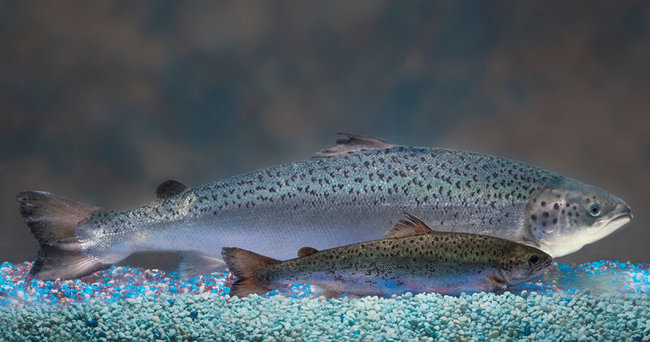
For a story about what we can expect in the future, let’s return to the 2012 post I wrote about a company awaiting final FDA approval to farm a genetically-altered salmon. Thirty years ago Aquabounty inserted two genes from other fish species in an Atlantic salmon that allows it mature much faster and to grow exponentially larger than the standard Atlantic salmon (see the photo at the head of this post). When I reported the AquaBounty story, the company had been waiting for ten years for approval. It was running out of money and about to be sold.
I followed up on this cliffhanger story for this post. Not only is Aquabounty alive and well, the company is raising its salmon in my backyard, so to speak. Its two midwestern facilities raise salmon in large indoor ponds that clean and recirculate water. This hydroponic model is sustainability at its best, but questions do remain. Will the public purchase and eat a fish-not-found-in-nature? Does it taste just like or better than other farmed salmon on a diet of manufactured food pellets that look like dog food?
My advice going forward is to confirm the source and freshness of the seafood you purchase. Store employees should be able to tell you where a fish was caught, whether it is wild or farmed and if it arrived frozen. In my experience, the staff is quite helpful and will retrieve the box a fish arrived in to answer your questions. I will continue on the lookout for the next fish story.
