
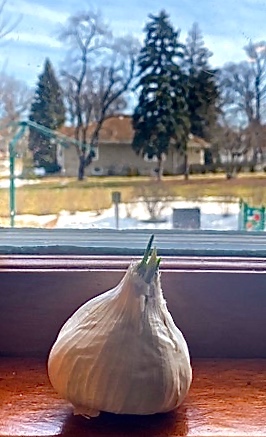
Three green blades sprouted from a head of garlic on my kitchen counter in early February as snow covered the ground outside my window. Soon green shoots appeared at the base of all onions that crossed my cutting board. How did these bulbs know it was time to grow into new plants?
The discovery that all plants contain a molecular clock that triggers their growth was made almost a century ago. Research began in Japan in the 1930's as a means to improve rice production. The stems of rice plants were collapsing before they set seed seriously limiting crop yields. Scientists found five hormones that work in tandem to stimulate and guide the growth of plants from dormancy through flowering.
My sprouting head of garlic had spent time in cool darkness before coming to market. During that time a molecular acid called gibberellin was gathering strength. In the warmth of my kitchen this hormone broke the garlic’s dormancy and set the bulb’s cells in motion to produce the next generation. The next question. Could gibberellin also initiate renewal in the human microbiome?
A few quick internet searches led me to ads for over-the-counter garlic supplements with added gibberellin and hormone-fortified sprays for plants. As many as 130 different sources of gibberellin acid have now been synthesized. None were as appealing as a natural source. Was there a hack for getting a gibberellin rush from garlic?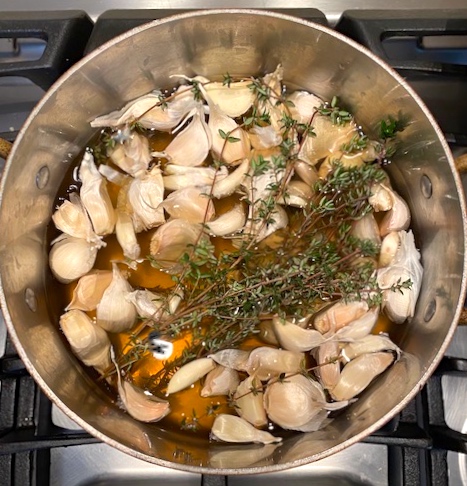
One would have to eat a raw clove of garlic, whole, to avoid the stink that is released once garlic's sulfur cells are activated by chewing. And the odor remains on ones breath as garlic slowly metabolizes and is vaporized in the lungs. I'm impressed by garlic's many health benefits, but I'd rather not make social distancing a way of life.
In the hands of a savvy cook, garlic will morph from it's raw Dr. Jekyll personality to a sweet Mr Hyde in minutes. Chopped garlic’s offensive sulfur compounds gradually disappear in a hot skillet leaving the carbohydrates free to break down and sweeten, up to a point. Cooked a second too long, these sugars turn bitter and the garlic becomes inedible. Spoiler alert: There's no proof that gibberellin's magical powers can survive the heat of an oven or skillet.
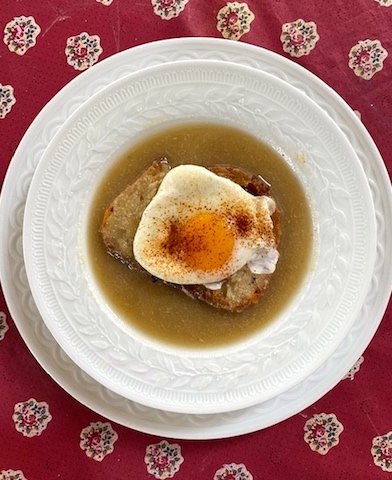
So, I console myself with a steaming bowl of soup made with the simmered whole cloves of four heads of garlic. Braised and pureed garlic is sweet and restorative. The addition of a poached egg and toast makes it a satisfying lunch and leaves me feeling fortified for the coming season.
GARLIC SOUP
Ingredients for 4 servings:
4 heads fresh garlic, peeled or unpeeled
1 bunch of fresh thyme (6-8 stems)
1 quart vegetable or chicken broth or water
Juice of 1 lemon
Kosher salt and freshly ground pepper
4 slices country bread, toasted
4 poached eggs
Garnish: smoked Spanish paprika
Break the heads of garlic into cloves, discarding the loose wrappings. Place cloves, peeled or unpeeled, and thyme stems in a saucepan, and cover with stock or water. Bring liquid to a simmer, and cook uncovered at a bare simmer for 15 minutes, or until the cloves are just tender. Remove the thyme stems and the garlic cloves with a slotted spoon. Pass unpeeled cloves through a food mill. Puree the peeled cloves with a cup of garlic broth. Return the garlic to the soup, add the lemon juice, and season to taste with salt and pepper.
Place the toasted bread rounds in the bottom of each soup bowl and pour on the soup. Garnish with a poached egg and sprinkle on paprika. Serve hot with a chilled glass of fruity white wine.
