Home cooks are constantly searching for their next culinary ‘fix’, be it an update of a familiar dish or an exotic recipe from another part of the world. Our kitchens counters are littered with time-saving equipment that deliver perfectly whipped egg whites, pureed pistou, and foam-capped espresso. Rarely does a recipe achieve worldwide acclaim with four ingredients, untended rests and a hot oven
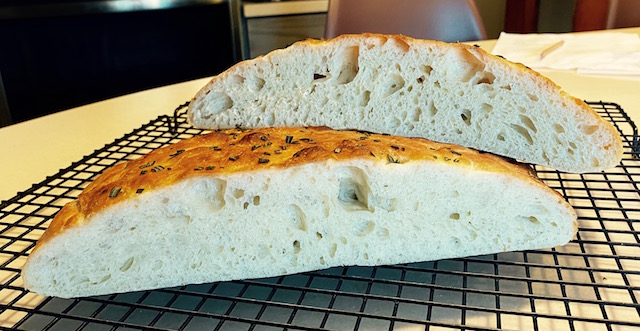
Such was the seismic response by home cooks to Jim Lahey’s No-Knead Boule recipe in The New York Times Good Eating section in November 2006. Lahey’s recipe contains less yeast, more water with a consistency easily mixed by hand. The dough rises slowly at room temperature and then is refrigerated overnight or longer. Still too soft to knead, the baker simply turns it into a Dutch oven to bake when desired. The result is an expanded round of flavorful bread, with a light, chewy texture and crisp, brown crust. How could a dough that requires so little labor and is so amenable to the baker’s schedule make such terrific bread?
The chemistry is as basic as it is compelling. A long rise allows yeast to proliferate as it feeds on the flour’s incomplete starch and sugar. Yeast activity produces alcohol and carbon dioxide which is trapped in the flour’s gluten strands causing the dough to rise. Home bakers have always kneaded dough to develop its gluten. Little did we suspect that the dough will structure gluten naturally in a wet dough given enough time. Home bakers who relied on kneading to work out their frustrations are encouraged to join a gym.
Several books, including one by Jim Lahey, have expanded the No-Knead technique to a wide variety of breads. The recipe that Catherine Damme sent me contains a little olive oil to aid in stretching the dough into flatbreads for focaccia and pizza. Unlike the original boule recipe which is baked in kettle, this dough can be assembled in the morning and baked in the afternoon for dinner. Our current stay-at-home condition offers first time and experienced bread bakers an unrivaled opportunity to work ‘the staff of life’ into their daily routine.
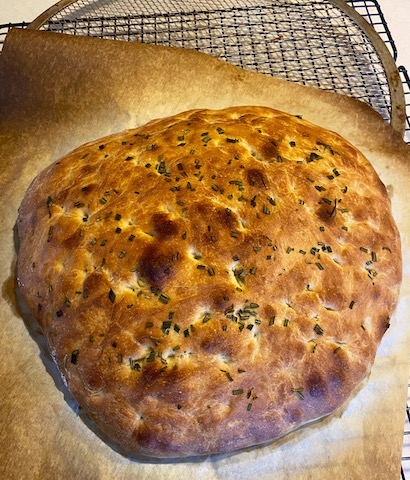
NO-KNEAD OLIVE OIL DOUGH
Ingredients for 1 large loaf
3 3/4 cups unbleached white flour
1/2 tablespoon instant yeast
2 teaspoons kosher salt
1 tablespoon sugar
1 2/3 cup water (at 100 degrees)
2 tablespoons olive oil
Focaccia:
2 tablespoons olive oil
1 teaspoon minced fresh rosemary
Mix the flour, yeast, salt and sugar together in a large bowl. Make a well in the center and pour in the water and olive oil. Work the dry into the wet ingredients to form a rough dough. Transfer the dough to another bowl that has been brushed with olive oil. Cover the bowl with plastic wrap, and leave in a sheltered place for 2 hours. Transfer the bowl to the refrigerator for 3 hours to firm it.
Remove the bowl from the refrigerator, place a pizza stone in the oven, and turn the temperature to 475 degrees. Lightly dust a circle on a piece of parchment. Scrape the dough onto the floured parchment and lightly flour the surface of the dough. Working with floured finger, smooth and stretch the dough into a 14” round. Allow the dough to rest for 20 minutes as the oven heats.
Poke to the bottom of the dough with fingers to create a pattern of holes. Brush on the olive oil and scatter on the rosemary. Slide the parchment onto a pizza screen or a cookie sheet. Place the focaccia on the stone and turn up the oven to 500 degrees. Bake for 15 - 20 minutes until the bread is golden brown. Remove the bread and slide it off the parchment onto a cooling rack. Cut when warm or at room temperature.
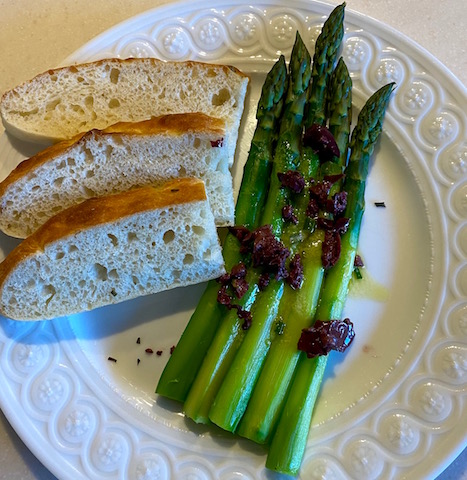
ASPARAGUS WITH LEMON VINAIGRETTE AND CHOPPED KALAMATA OLIVES
