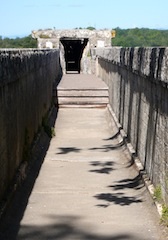
Watercourse channel across the Pont du Gard
As the TGV high-speed rail service whisked me from Paris to Avignon last month, I wrote out grocery lists for meals my tour clients would prepare in the coming week. I imagined shopping the weekly markets in Uzes for succulent black figs, plump wild mushrooms and newly cracked brine-soaked Picholine olives. Staring at the Evian bottle on my tray table, I also flashed on the most precious commodity in Provence. Water.
Visits to the remarkable Gallo-Roman sites in Provence are as essential to understanding its culture as is its cuisine. The Pont du Gard is the Romans' spectacular solution to perennial problem of moving water to where people can best use it, in this case, Nimes, thirty miles south. A morning visit is a ‘must’ on our week-long Provence Odyssey.
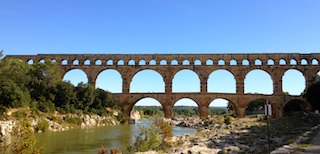
There is so much to marvel standing below a massive barrel vault of this three-tiered Roman bridge. It may be a UNESCO World Heritage site (since 1985), but it is only a fragment of the 31 mile long Nimes Aqueduct most of which is underground. Two thousand years ago this covered watercourse carried 200,000 cubic meters of spring water from Uzes, 11 miles to the northeast, over the Gardon River, to the garrison town of Nimes, twenty miles away. Parisians, by comparison, did not have freshly piped water until the middle of the 19th century.
A wonderful archeological museum at the left bank entrance explains everything you could ever want to know about the aqueduct’s exacting construction. The gradient along its route, for example, was only 56 feet. It drops only one inch along the entire 365 yard length of the Pont du Gard! To encourage the flow, of water, the interior channels were carefully prepared with olive oil and maltha, a mixture of pork fat, slaked lime and the thick juice of unripened figs. Before I leave the museum I have to watch the three minute 'bird's-eye-view” video taken from the one-man ultra-light airplane as it follows the water's route under the rolling plains and through shrubby terrain of the Department of Gard.
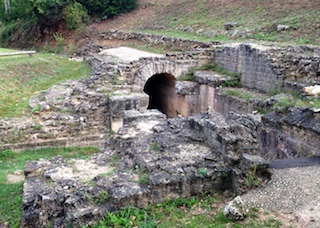
Remains of Uzes Aqueduct
This year I rented a house in charming medieval town of Uzes where abundant springs supply the town's water supply even today. My walk down from the town to the remains of the Roman aqueduct, however, required the perseverance and climbing skills of a mountain goat. The town’s tourist map shows its location but once off the street, the path is unmarked. Steep steps down to the river consist of an uneven series of switch-backs, with no handrails for support.
I found the limestone remnants of the aqueduct and a single marker easily in open meadow. One would never guess this relic was in any way related to the carefully landscaped Pont du Gard. I complained at the mairie (town hall) in Uzes and at the tourist office about this neglectful treatment of their patrimoine (the French are very proud of their heritage). The officials I spoke to at each location told me the other was the responsible party.
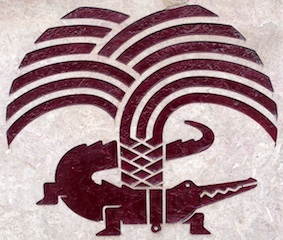
The city of Nimes, on the other hand eagerly embraces its Roman heritage. It has adopted a modern logo of a stylized crocodile chained to a palm tree. This is a reference to Julius Caesar’s conquest of Egypt in the successful Battle of the Nile in 47 BC. Caesar retired his Roman legionaires from that campaign here and gave them small plots of land to farm .
The ancient watercourse made its entry into Nimes at Le Castellum, an easy ten minute walk from the historic Maison Carré with the help of the city map. It consists of a shallow circular basin and the vestiges of channels that carried water out to the city that had 60,000 residents in the middle of the 1st century AD. A decline in the upkeep of the aqueduct accompanied the weakening of the Roman Empire and its fall in the fourth century. The water was further reduced to a trickle by the 6th century when calcium build-ups from the limestone walls began to fill the channels.
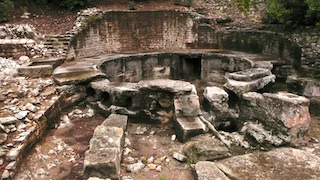
Le Castellum
